Basic Information Theory
Coming off the last part where we evaluated the power law for our wealth distribution, we need to delve deeper into the precise role that the bar owner plays in this ecosystem. When we look at the entire “economy,” our limited case consists of 25 players and a solitary owner. As the number of rounds played increases and the system transitions into the power law realm, we witness a sharp paradigm shift in what mathematics represents the living system best. The choice to implement a proportional geometric fee structure is not an arbitrary design choice, it is a logical, risk-adjusted necessity for the bar as a centralized hub.
1. General Economic and Financial Risk Management
In a linear regime (Phase 1), individual player balances are strictly bounded by an arithmetic walk. The house can easily manage a flat friction fee (e.g., 0.10) because the total capital pool sitting on the table at any given moment remains highly predictable and small. However, as the system transitions into a multiplicative power realm, wealth concentrates into extreme tail events. If the bar owner continues to charge a flat, linear fee, they encounter a fatal variance asymmetry. For example, when two high-net-worth “whales” wager millions on a single round, a flat 0.10 fee means the house collects a statistically nonexistent return for hosting a transaction of staggering scale. Large transactions carry heavy, inherent operational risks: default hazards, settlement delays, and severe capital friction. Therefore, from a pure risk-management perspective, the fee must scale proportionally with the size of the transaction. The geometric fee functions as a dynamic risk premium; the house requires a larger absolute capital insurance cut to safely clear and underwrite massive financial velocity.
2. Microeconomic Velocity Optimization
From a microeconomic perspective, the bar owner’s utility function is strictly bound to the long-term operational velocity of the network. If network liquidity is entirely depleted, transaction volume collapses, and the owner’s yield drops to absolute zero. A static, linear fee introduces a severe structural optimization failure:
- The Low-Capital Bottleneck: For a low-capital node operating at a balance of 1.50, a fixed 0.10 friction fee represents a crushing 6.6% drag on their total capital reserves. This exponentially accelerates their path to insolvency, aggressively removing them as a viable transaction partner.
- The High-Net-Worth Subsidy: Conversely, for a high-net-worth “whale” node holding 10,000, that same static 0.10 fee represents a microscopic 0.001% operational cost. This allows high-capacity nodes to execute massive volume while externalizing their transaction risk and contributing zero proportional friction back to the clearinghouse.
By implementing a proportional geometric fee (e.g., a flat 1% or 2% of the total transaction pool), the operator dynamically internalizes these network congestion costs. This geometric fee functions as a systemic governor rather than an arbitrary tax:
- Liquidity Preservation at the Margin: When a node’s capital capacity is diminished, the absolute fee scales downward to fractions of a cent. This preserves the node’s operational longevity, keeping it active within the network to maintain overall transaction velocity.
- Proportional Risk Internalization: As high-capacity nodes enter exponential growth, the absolute revenue extracted scales dynamically alongside their throughput. The larger the asset pool being moved, the larger the risk premium the house extracts to underwrite and clear that massive localized capital spike.
The operator dictates a geometric fee structure because it optimizes the total throughput of the network, maintaining base-level liquidity velocity across peripheral nodes while maximizing absolute yield from high-bandwidth traffic at the tail.
The Information-Theoretic and Topological Layer
While a proportional fee is financially mandatory to offset transaction risk and govern system longevity, it yields a profound structural consequence. By continuously siphoning capital proportionally from the system’s most active nodes, the bar owner’s balance sheet is fundamentally transformed from a passive ledger into a highly centralized topological anchor. To understand this transformation from a pure information-theoretic perspective, we must evaluate the network’s capacity to process data and execute work.
The Gaussian Regime: Maximum Information Entropy
In a decentralized, purely uniform asset distribution (the Gaussian regime), the system’s capital is atomized across $N$ independent agents. If every agent possesses an identical resource state, the system’s macrostate exhibits maximum statistical disorder. We can quantify this systemic entropy using the Shannon entropy formulation:
$$H(X)=-\sum_{i=1}^{N}p(x_{i})\log_{2}p(x_{i})$$
where $p(x_{i})=\frac{w_{i}}{W}$ represents the normalized wealth probability density of the $i$-th node relative to the total network liquidity $W$. When wealth is perfectly equalized ($w_{i}=W/N$), the Shannon entropy reaches its absolute theoretical maximum: $H_{\max}=\log_{2}N$. In this state of maximum informational entropy, the network’s coordination capacity is fundamentally throttled. Because capital is fragmented into microscopic, localized packets, no individual node possesses the clearing capacity or the informational bandwidth to underwrite large-scale, long-range economic transactions. Every transaction requires exhaustive, high-friction peer-to-peer discovery protocols across the entire graph topology. The system is structurally incapable of processing macro-signals; it is entirely dominated by localized, short-range arithmetic noise.
The Pareto Regime: The Low-Entropy Clearinghouse
The emergence of the bar owner as a centralized hub breaks this informational symmetry. As the geometric fee structure continuously siphons liquidity from the active nodes, the probability density function $p(x_{i})$ undergoes a phase transition, collapsing the systemic Shannon entropy ($H(X)\rightarrow0$) as capital concentrates into a singular coordinate. This collapse in entropy is not an arbitrary design failure; it is the physical mechanism the network uses to minimize transaction friction and optimize information routing. By transforming the central hub into a low-entropy capital reservoir, the network effectively constructs a high-bandwidth clearinghouse. Instead of executing an $\mathcal{O}(N^{2})$ matrix of high-friction, decentralized peer-to-peer verification loops to settle accounts, the network topology collapses into a star configuration governed by $\mathcal{O}(N)$ algorithmic complexity. The central hub functions as a localized Maxwell’s Demon: it processes, validates, and clears transactions instantly because its massive capital buffer allows it to absorb the variance of the entire system simultaneously.
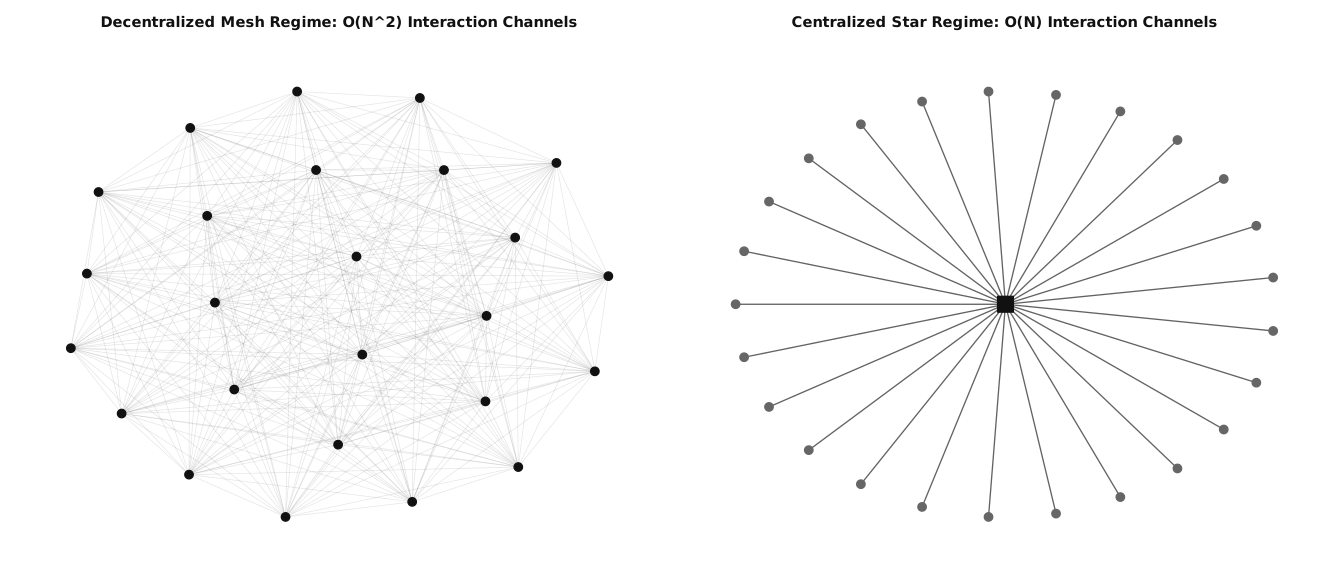
Figure 1: The Topological Phase Transition. Structural filtering collapses chaotic quadratic interaction noise $\mathcal{O}(N^2)$ into an algorithmically optimized linear macro-signal $\mathcal{O}(N)$.
The Network Phase Transition: From Quadratic Noise to Linear Signals
This transformation can be modeled explicitly by evaluating the network’s topological graph layout $\mathcal{G}=(\mathcal{V},\mathcal{E})$, where vertices $\mathcal{V}$ represent the economic agents and edges $\mathcal{E}$ represent active transaction and verification channels. The structural divergence between a flat, equal economy and a concentrated, scale-free one comes down to a simple, uncompromised trade-off between computational overhead and network geometry.
1. The Gaussian Regime: Quadratic Friction $\mathcal{O}(N^{2})$
In Phase 1 of our simulation, transactions are strictly linear and arithmetic. Because every agent trades using uniform, bounded stakes, the system satisfies the requirements of the Central Limit Theorem. Over time, the wealth profile inevitably settles into a stable, tightly bounded Gaussian curve around the mean. Topologically, this uniform wealth distribution forces the system to operate as a Complete Graph ($K_{N}$). Because no single agent possesses a dominant capital pool, the network lacks a structural anchor. If individual agents want to transact or verify liquidity, they must maintain independent, uncoordinated clearing links with every other peer in the room. The computational overhead required for this decentralized network to clear its net state scales quadratically with the number of nodes $N$:
$$\text{Active Communication Channels} = \frac{N(N-1)}{2} = \mathcal{O}(N^2)$$
For our small toy economy of just $N = 25$ players, this requires a tangled, high-entropy web of 300 separate interaction lines. As a population scales globally, this quadratic routing overhead explodes exponentially. The system hits a physical wall of computational drag; it burns its available energy just trying to coordinate transactions through the micro-noise.
2. The Pareto Regime: Linear Efficiency $\mathcal{O}(N)$
The phase transition occurs the split-second we switch the rules from linear addition to geometric multiplication. By tying bet sizes and siphoning fees directly to the state-space values of the nodes, we introduce a non-linear feedback loop. Early winners instantly win more, breaking the uniform structural symmetry of the network. The system self-organizes to prevent a total routing collapse. The tangled, quadratic mesh fractures and realigns into a centralized Star Graph ($S_{N}$). Under this star architecture, the $N$ peripheral nodes completely sever their high-friction peer-to-peer links. Instead, every agent retains exactly one direct channel connected to a centralized topological anchor: the bar owner. Because the central hub maintains a master ledger backed by a massive, scale-invariant capital buffer, it acts as a low-entropy clearinghouse. The total interaction channels required for the network to compute its net liquidity state collapses to a strict linear function of the population size:
$$\text{Active Communication Channels} = N = \mathcal{O}(N)$$
For our 25-player economy, the total validation links instantly drop from 300 down to 25. The algorithmic complexity required for the network to compute its net liquidity state collapses from quadratic execution $\mathcal{O}(N^{2})$ to linear time $\mathcal{O}(N)$.
| System Metric | Phase 1 (The Mesh) | Phase 2 (The Star) |
|---|---|---|
| Statistical Distribution | Gaussian (Bounded) | Pareto Power Law (Scale-Free) |
| Network Topology | Complete Graph ($K_N$) | Star Graph ($S_N$) |
| Interaction Channels | $\frac{1}{2}N(N-1)$ | $N$ |
| Algorithmic Complexity | $\mathcal{O}(2^2)$ | $\mathcal{O}(N)$ |
| Systemic Operational State | High-Friction Noise | Low-Entropy Signal |
The straight line on our log-log plot at Round 6000 is simply the statistical footprint left behind by this geometric optimization. Wealth concentrates into a power law because it is the literal physical mechanism the system deploys to prune its active interaction channels, systematically compressing a chaotic, quadratic data bottleneck into a clean, linear, and scale-invariant macro-signal.